Melbourne Grand Prix — YMML Parking Update (Mar 5–8, 2026)
Universal Aviation Australia reports that Melbourne Tullamarine (YMML) is nearly at parking capacity for the Formula One Grand Prix period, with only 2 of 17 GA parking positions remaining. Operators should coordinate immediately to secure space. Aircraft unable to obtain parking at YMML may need to reposition to Essendon Fields (YMEN) or other alternate airports.
The 2026 Australian Grand Prix will be held March 5–8 at Albert Park in Melbourne.
Unlike slot-controlled events such as Monaco or Singapore, the primary aviation impact in Melbourne is temporary restricted airspace and concentrated helicopter activity over the race circuit. Fixed-wing operations remain manageable with proper coordination, but operators should review AIP SUP H23/26 and monitor Melbourne FIR (YMMM) NOTAMs for activation timing.
“The Australian Grand Prix is operationally manageable for fixed-wing operators,” said Derek O’Reilly, General Manager, Universal Aviation Australia. “The key is understanding that the main impact is airspace segmentation over Albert Park, not airport slot compression. Early coordination eliminates most surprises.”
Airspace Impact: Albert Park
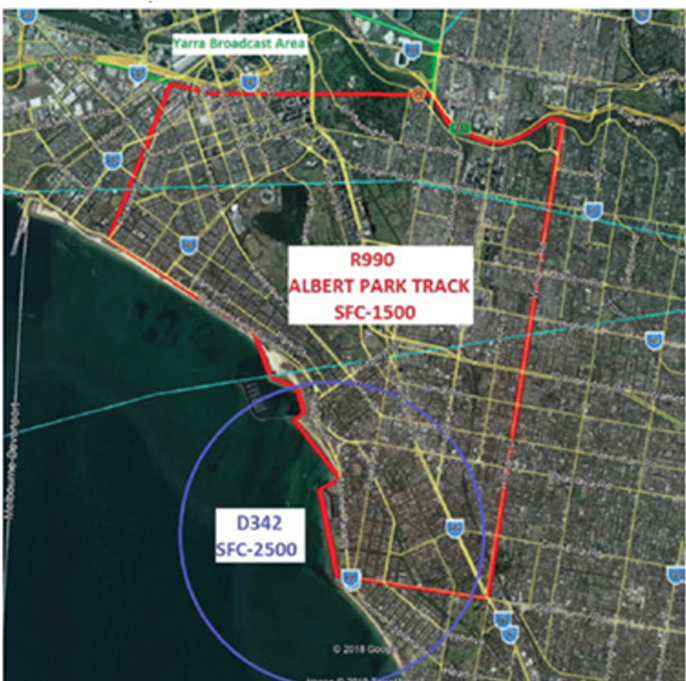
Two Temporary Restricted Areas (TRA) will be active during the event:
- TRA R990 – “TRACK UNICOM”
- Surface to 1,500 feet
- Expected daily activation: 0800–1830 local (via NOTAM)
- TRA R992 – “AIR DISPLAY”
- Surface to BCTA
- Activated during scheduled RAAF air display windows
Helicopter operations supporting the event into the Albert Park Helicopter Landing Site require prior approval through Professional Helicopter Services (PHS).
Aircraft operating within TRA R990 must:
- Register with PHS
- Maintain a listening watch on 127.00 MHz
- Broadcast in accordance with non-controlled aerodrome procedures
- Accept pilot responsibility for separation
No ATC separation is provided within R990. During activation of TRA R992, access is restricted to display aircraft and those approved by the controlling authority. Airspace will be sanitized prior to display activity.
“For rotor operators, compliance and prior coordination are essential,” O’Reilly said. “Last-minute helicopter requests during peak race days are unlikely to be accommodated.”
For fixed-wing operators into Melbourne’s primary airports, the impact is generally limited to awareness of low-level restrictions near central Melbourne rather than operational denial of access.
Primary airports
Melbourne Tullamarine (YMML)
YMML remains the primary airport for international and heavy aircraft operations.
- 24-hour operations
- 11,998-foot runway
- No slot or PPR requirement
- 24-hour Customs, Immigration, and Quarantine (CIQ)
- Off-Terminal Clearance available with prior coordination
YMML has significant apron capacity and infrastructure capable of supporting large cabin and heavy aircraft. Parking demand increases during Grand Prix weekend, but with advance planning remains manageable.
Parking Alert — Melbourne Tullamarine (YMML)
Universal Aviation Australia advises that as of Feb. 18, 2026, YMML is nearly at parking capacity for the F1 period, with only 2 of 17 parking spots remaining. Aircraft may be required to use YMEN as an alternate airport.
Best suited for: International arrivals, large cabin aircraft, 24-hour operations.
Essendon Fields (YMEN)
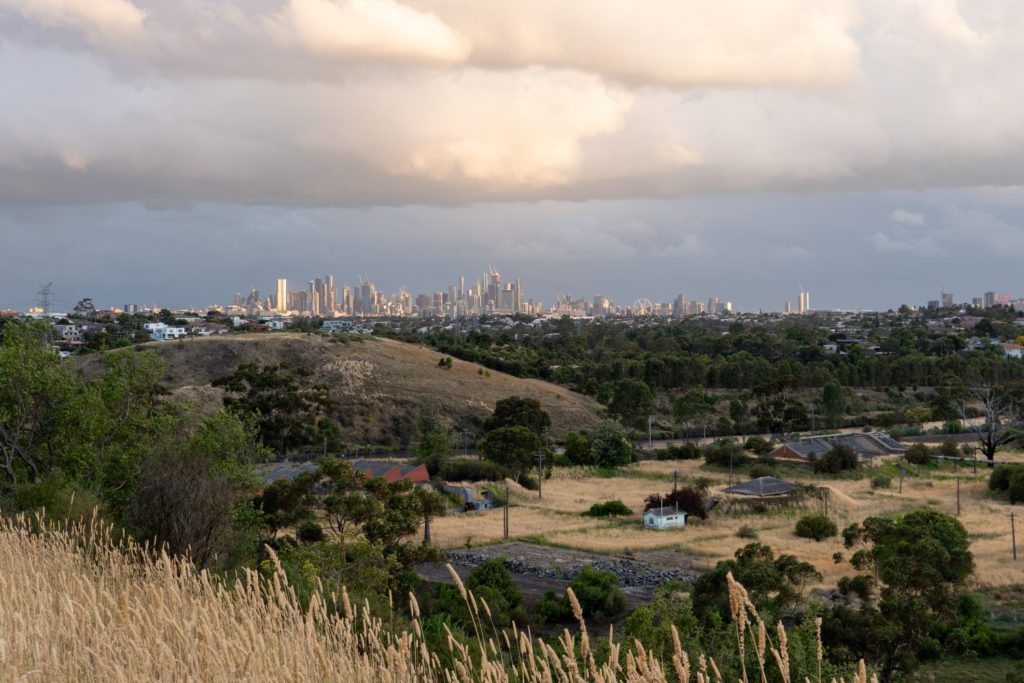
View of Melbourne skyline from Essendon
YMEN offers closer proximity to the city but comes with operational limitations.
- Runway length: 6,302 feet
- Maximum weight: 50,000 kg
- Curfew: 2300–0600 local
International arrivals require prior approval and coordination with Australian Border Force. Customs availability depends on officer positioning from YMML.
Best suited for: Smaller aircraft meeting runway and weight limits that do not require late-night departures.
Avalon (YMAV)
YMAV operates 24 hours and provides ample parking capacity.
Important limitation:
- Domestic airport only
- International flights must clear at an Airport of Entry before repositioning
Best suited for: Repositioning or long-term parking after passenger drop at YMML.
Landing Permits and Regulatory Requirements
Australia does not require landing permits for private non-revenue operations.
Charter (non-scheduled commercial) operators must obtain approval from the Civil Aviation Safety Authority (CASA). Standard processing lead time is typically a minimum of five business days. First-time or infrequent foreign charter operators must complete CASA Form 094 and maintain an approved Transportation Security Program (TSP), which may require extended lead time.
All passengers and crew must hold valid Australian visas prior to arrival.
Australia enforces strict biosecurity controls. Fresh and unprocessed food items not pre-approved must be surrendered upon arrival.
“These regulatory requirements are not event-driven,” O’Reilly said. “The Grand Prix does not introduce new entry restrictions for fixed-wing operators. The key is ensuring standard Australian compliance is completed early.”
Ground Handling and Fuel
Full GA ground handling is available at YMML, YMEN, and YMAV.
Advance fuel coordination is recommended during peak arrival and departure days. Overnight parking should be confirmed in advance at YMML if required.
Customs, Immigration & Visas
- All passengers and crew must have a visa before arrival. Some nationalities can apply online, others require embassy-issued visas.
- CIQ Clearance:
- YMML: Main terminal processing, with a dedicated crew clearance line.
- YMEN: Must be pre-approved 10 days in advance.
- Melbourne Jet Base at YMML offers a private CIQ processing facility.
- Quarantine Rules: All fresh/unprocessed food must be disposed of upon landing unless pre-approved by an Australian quarantine officer.
Hotels & Local Transport

- Luxury hotels fill up fast – Book 4- and 5-star crew accommodations early.
- Pre-arranged transport is highly recommended – Chauffeured cars and rental vehicles are available at all three airports.
Planning Considerations
- Review AIP SUP H23/26 and monitor YMMM NOTAMs
- Coordinate helicopter operations early through PHS
- Secure parking in advance for overnight stays
- Confirm CASA approvals and visa compliance well before departure
- Consider YMAV for repositioning if long-term parking is required
Conclusion
The Australian Grand Prix presents a structured and predictable operating environment. The primary aviation impact is temporary restricted airspace over Albert Park and elevated helicopter density during race hours.
With early coordination and regulatory compliance confirmed, Melbourne remains fully manageable for business aviation operations during event week.
Universal Aviation Australia can assist with airport selection, CASA coordination, airspace interpretation, and contingency planning.