


Europe summer 2026 business aviation parking guide
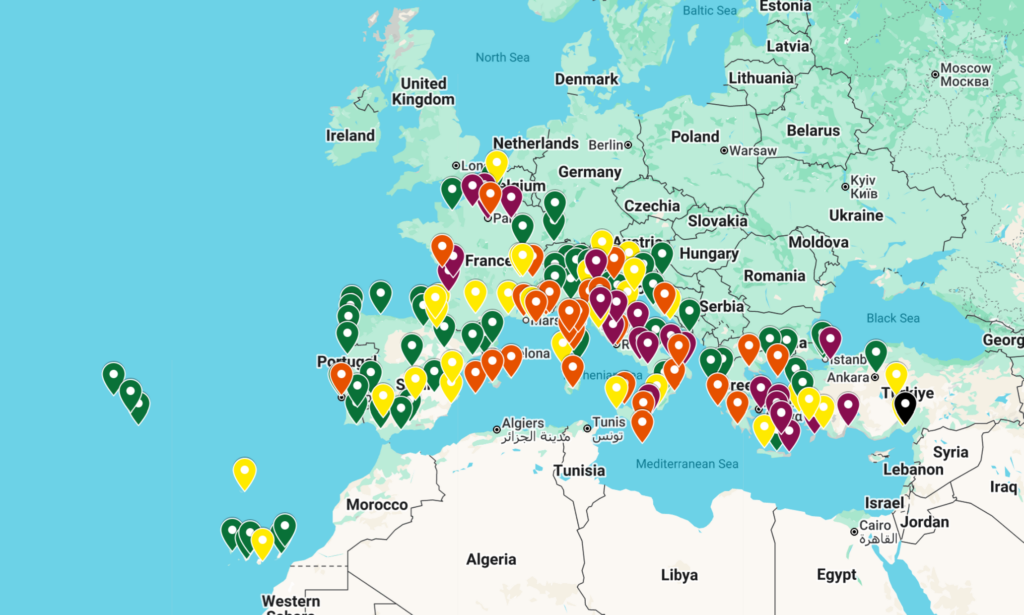
Summer parking in Europe is not a single regional problem. It is a collection of local constraints that vary by airport, aircraft type, operating window, event demand, and whether the flight is carrying passengers or positioning.
The biggest planning mistake is assuming that landing approval also means the aircraft can remain on the ground.
At many Mediterranean airports, passengers may be accepted while the aircraft is limited to a quick turn, a 40-minute ground time, a short overnight window, or immediate repositioning. In other markets, long-term parking is generally available but can tighten quickly during major events or peak leisure demand.
What operators need to know
- Greece presents the most complex combination of island demand, short ground times, PPR requirements, and long-distance repositioning.
- Italy generally offers options, but availability is highly airport-specific and frequently changes trip by trip.
- France becomes most difficult around Paris, the Mediterranean coast, and Corsica.
- Most of Spain remains workable, but Ibiza, Palma de Mallorca, and Menorca can move to drop-and-go restrictions during peak periods.
- Lisbon should be planned as a drop-and-go operation, with the aircraft repositioned elsewhere.
- Malta offers limited recovery options when parking is unavailable.
- Croatia’s coastal airports are more constrained than its inland airports.
- Türkiye generally offers better long-term parking flexibility, but resort airports and Istanbul options still require airport-specific planning.
Interactive Parking Options Map Guide for Europe Summer 2026
What is the biggest parking mistake operators make in Europe?
The most common mistake is choosing the passenger airport first and addressing aircraft parking later.
That approach fails when the destination permits a landing but does not approve an overnight stay. By that point, nearby alternates may also be full, unsuitable for the aircraft, outside airport operating hours, or separated from the destination by several hours of ground transportation or a ferry connection.
The better approach is to plan the passenger arrival, aircraft parking, crew position, fuel, and return schedule as one operating chain.
Greece: the aircraft may need a different destination than the passengers
Greece has some of the most restrictive summer parking conditions in Europe, particularly at island airports.
PPR and slots are generally applied for 14 days before operation. Joint military airports require four business days of lead time and may also require an additional landing permit.
Long-term parking is generally available at Alexandroupoli Airport (LGAL), Skiathos Airport (LGSK), Kavala International Airport (LGKV), Ioannina Airport (LGIO), Mytilene International Airport (LGMT), Samos International Airport (LGSM), Sitia Airport (LGST), Nea Anchialos National Airport (LGBL), Lemnos International Airport (LGLM), Chania International Airport (LGSA), and Kos International Airport (LGKO).
Nea Anchialos National Airport (LGBL), Lemnos International Airport (LGLM), and Chania International Airport (LGSA) are joint military airports and require an additional landing permit.
Kos International Airport (LGKO) generally permits long-term parking, but a €2,000 charge is added to the handling cost for each live leg.
Where parking becomes difficult
At Athens International Airport (LGAV), parking is limited to 1.5 hours. Requests for longer stays can only be submitted the day before arrival. Listed alternate options include Thessaloniki Airport (LGTS), Ioannina Airport (LGIO), Nea Anchialos National Airport (LGBL), and the Athens maintenance ramp.
At Corfu International Airport (LGKF), parking is limited to 1.5 hours through Sept. 30. Only two overnight stands are available, and these are usually allocated to airlines. Ioannina Airport (LGIO) is the listed alternate.
Thessaloniki Airport (LGTS) is subject to PPR. During the peak of the season, the unofficial maximum stay is five days. No GAT is available. Kavala International Airport (LGKV) and Alexandroupoli Airport (LGAL) are listed alternates.
Heraklion International Airport (LGIR) is not regulated for stays of up to two hours, after which PPR applies. During peak months, positioning flights are generally not accepted, although overnight parking may sometimes be approved for passenger flights. No GAT is available.
Mykonos International Airport (LGMK) permits a maximum ground time of 40 minutes between 0400-1930 UTC through Sept. 15. Between 1930-0400 UTC, the same parking limitation does not apply. A €2,000 charge is added to the handling cost for each live leg.
Santorini International Airport (LGSR) permits a maximum ground time of 40 minutes between 0500-1800 UTC through Sept. 15. The restriction does not apply between 1800-0500 UTC.
At both Mykonos and Santorini, schedule timing can determine whether the aircraft must reposition or may remain overnight.
Other restrictions
- Zakynthos International Airport (LGZA): Short ground time; overnight parking is normally not approved.
- Aktion Airport/Preveza (LGPZ): Parking subject to PPR; airport of entry on request; pets cannot be cleared; additional military permit required.
- Paros National Airport (LGPA): Quick-turn only; no fuel; EU and Schengen flights only.
- Rhodes International Airport (LGRP): Quick-turn only; overnight parking may occasionally be approved for a late arrival and early departure.
- Kalamata International Airport (LGKL): Quick-turn only; joint military; additional landing permit required.
- Kefalonia International Airport (LGKR): Subject to PPR; unofficial peak-season maximum stay of five days; €2,000 handling charge per live leg.
“The part that catches operators out in Greece is parking the aircraft after the passengers get off. You may be able to get into the island, but that does not mean the aircraft can stay there. We need to solve the reposition, crew, and return plan before the trip is locked in.”
— Joey Fleming, Master Mission Advisor at Universal
Italy: parking is available, but the answer changes airport by airport
Italy offers more long-term parking options than many Mediterranean markets, but there is no single national parking pattern.
Long-term parking is generally available or normally workable at Foggia Airport (LIBF), Lamezia Terme International Airport (LICA), Olbia Costa Smeralda Airport (LIEO), Milan Malpensa Airport (LIMC), Milan Bergamo Airport (LIME), Turin Airport (LIMF), Milan Linate Airport (LIML), Cuneo International Airport (LIMZ), Forlì Airport (LIPK), and Rimini Federico Fellini International Airport (LIPR).
Genoa Airport (LIMJ) generally supports long parking, although stand shortages can occur during special events.
Bologna Guglielmo Marconi Airport (LIPE) may support long parking when requested in advance, but Formula 1, MotoGP, and other major events can materially affect availability.
Brescia Airport (LIPO) generally supports long parking, although overnight stays may be restricted when scheduled cargo activity takes priority.
Airports requiring trip-specific review
Ancona International Airport (LIPY), Reggio Calabria Airport (LICR), Parma Airport (LIMP), Treviso Airport (LIPH), Trieste Airport (LIPQ), Bolzano Airport (LIPB), Comiso Airport (LICB), Palermo Airport (LICJ), Trapani Airport (LICT), Alghero Airport (LIEA), and Cagliari Airport (LIEE) all require trip-specific review during summer.
Treviso is particularly difficult for overnight parking because of limited stand availability. Palermo normally accepts only quick turns during summer, while Cagliari generally does not permit overnight parking during the peak season.
Airports with defined limits
Venice Marco Polo Airport (LIPZ) permits only quick turns from May through September. Outside peak season, parking is limited to 48 or 72 hours depending on the month.
Pisa International Airport (LIRP) permits a maximum of 72 hours when parking is available. Airport operating hours are 0400-2055 UTC, and extensions are not possible.
Brindisi Airport (LIBR) does not permit long-term parking and limits aircraft to three hours on the ground.
Rome Ciampino Airport (LIRA) operates under a daily movement cap. Long-term parking is limited to locally based operators and is not permitted for ferry flights.
Rome Fiumicino Airport (LIRF) generally accepts GA only at night. Long-term parking is normally not accepted.
Bari Airport (LIBD) limits aircraft to three hours on the ground during summer and operates from 0800-2000 local.
Pescara Airport (LIBP) does not permit long-term parking during high season.
Naples International Airport (LIRN) permits a maximum ground time of three hours.
Perugia Airport (LIRZ) permits quick turns only and no overnight parking.
Salerno Costa d’Amalfi Airport (LIRI) generally permits only quick turns during summer, although stays of up to 24 hours may be approved based on availability.
Catania-Fontanarossa Airport (LICC) permits quick turns only during the summer season.
Aircraft and service limitations
Verona Boscomantico Airport (LIPN) is suitable only for small VFR and aeroclub aircraft.
Crotone Airport (LIBC) has significant service and CIQ limitations. Lamezia Terme International Airport (LICA) is the preferred alternative.
Siena-Ampugnano Airport (LIQS) is restricted to small GA aircraft, EU and Schengen operations, and CIQ on request.
Grosseto Airport (LIRS) permits long-term parking but operates on a sunrise-to-sunset schedule influenced by military activity. Extensions are not permitted.
Florence Airport (LIRQ) is usually quick-turn only, although remote parking may occasionally be available for aircraft up to Gulfstream G550 size.
Verona Villafranca Airport (LIPX) is quick-turn only.
“Italy usually gives us options, but the closest airport is not always the best one operationally. Aircraft size, airport hours, local events, and whether the flight is live or positioning can all change the answer.”
— Joey Fleming, Master Mission Advisor at Universal
France: peak demand pushes aircraft away from the destination
France becomes most difficult around Paris, the Mediterranean coast, and Corsica.
Long-term parking is generally available when no major event is affecting demand at Caen-Carpiquet Airport (LFRK), Basel-Mulhouse Airport (LFSB), Dijon-Bourgogne Airport (LFSD), Strasbourg Airport (LFST), and Albert-Picardie Airport (LFAQ).
Albert-Picardie Airport (LFAQ) is identified as a primary parking option during the Paris Air Show. Pontoise-Cormeilles Airport (LFPT) may also be considered.
Paris
Paris Le Bourget Airport (LFPB) is subject to approval. Parking becomes highly unlikely during the Paris Air Show.
Paris Orly Airport (LFPO) does not permit parking. Listed alternates include Caen-Carpiquet Airport (LFRK), Dijon-Bourgogne Airport (LFSD), and Strasbourg Airport (LFST).
Paris Charles de Gaulle Airport (LFPG) is generally available only for a connection flight or late takeoff. Overnight parking is not permitted.
Pontoise-Cormeilles Airport (LFPT) and Melun-Villaroche Airport (LFPM) are the closest listed alternatives.
Southern France and Corsica
Parking is approval-dependent and frequently unlikely at Figari-Sud Corse Airport (LFKF), Ajaccio Napoléon Bonaparte Airport (LFKJ), Cannes-Mandelieu Airport (LFMD), Marseille Provence Airport (LFML), Nice Côte d’Azur Airport (LFMN), Calvi-Sainte-Catherine Airport (LFKC), and Toulon-Hyères Airport (LFTH).
Nice alternates include Cuneo International Airport (LIMZ), Genoa Airport (LIMJ), and Girona-Costa Brava Airport (LEGE).
Cannes-Mandelieu Airport (LFMD) requires aircraft type information before parking can be evaluated.
Marseille Provence Airport (LFML) and Toulon-Hyères Airport (LFTH) require PPR.
Corsican operations may require repositioning to mainland France or Italy.
Other limitations
- Châlons Vatry Airport (LFOK), Beauvais-Tillé Airport (LFOB), and Rouen Vallée de Seine Airport (LFOP): Limited GA services.
- Bordeaux Airport (LFBD): Drop-and-go only.
- Cognac-Châteaubernard Air Base (LFBG): Military airport; no parking.
- La Rochelle Airport (LFBH): Very limited parking; normally no more than an overnight when planned in advance.
- Bastia-Poretta Airport (LFKB): Very limited weekday parking.
- Lyon-Bron Airport (LFLY): Subject to approval; aircraft type required.
- Lille Airport (LFQQ) and Pontoise-Cormeilles Airport (LFPT): Subject to availability.
“In France, waiting on the preferred airport can work against you. During busy periods, it is often better to secure a workable stand farther away than hold out for the closest airport and lose the better alternates.”
— Joey Fleming, Master Mission Advisor at Universal
Spain: the mainland is generally workable, but the islands are different
Spain has one of the more favorable overall parking outlooks in the region.
Long-term parking is generally available, or shortages are uncommon, at Bilbao Airport (LEBB), Barcelona-El Prat Airport (LEBL), Girona-Costa Brava Airport (LEGE), Granada Airport (LEGR), Jerez Airport (LEJR), Madrid-Barajas Airport (LEMD), Málaga Airport (LEMG), and Santiago de Compostela Airport (LEST).
Parking is also generally subject to approval without known recurring restrictions at Albacete Airport (LEAB), Asturias Airport (LEAS), Badajoz Airport (LEBZ), A Coruña Airport (LECO), Reus Airport (LERS), Vitoria Airport (LEVT), Vigo Airport (LEVX), Zaragoza Airport (LEZG), Fuerteventura Airport (GCFV), La Palma Airport (GCLA), Lanzarote Airport (GCRR), Tenerife South Airport (GCTS), and Tenerife North Airport (GCXO).
Barcelona-El Prat Airport (LEBL) generally supports long-term parking, although major events can tighten availability.
Alicante-Elche Airport (LEAL) normally supports long stays, but peak-season shortages may occur.
The Balearic Islands
Ibiza Airport (LEIB) experiences significant summer shortages and restrictions. Aircraft with wingspans greater than 21 meters may be limited to three hours on the ground and required to operate drop-and-go.
Long-term remote parking on the K ramp may be possible, but all towing to and from the ramp must occur during daylight. Night towing and taxiing are not permitted.
Menorca Airport (LEMH) may also restrict aircraft to three hours on the ground during summer.
Palma de Mallorca Airport (LEPA) experiences significant parking shortages and can impose a three-hour maximum ground time.
One hangar is available at Palma on a first-come, first-served basis, but it should not be treated as a dependable parking solution.
Other constrained airports
Pamplona Airport (LEPP), San Sebastián Airport (LESO), and Gran Canaria Airport (GCLP) have limited availability.
Valencia Airport (LEVC) can experience summer shortages and restrictions.
Seville Airport (LEZL) has only six parking positions.
Igualada-Òdena Aerodrome (LEIZ) is private and must be contacted directly regarding parking.
“The mistake is assuming the Balearics will behave like mainland Spain. Ibiza, Palma, and Menorca can tighten up very quickly, especially for larger aircraft, so we plan those stops as a separate parking problem.”
— Joey Fleming, Master Mission Advisor at Universal
Portugal: Lisbon requires a reposition plan
Portugal offers several viable long-term parking options, but Lisbon itself does not.
Lisbon Airport (LPPT) permits no parking and limits ground time to 45 minutes.
Listed alternates include Cascais Municipal Aerodrome (LPCS), Beja Airport (LPBJ), and Porto Airport (LPPR).
Cascais Municipal Aerodrome (LPCS) supports long-term parking and has no known slot or parking restrictions, but its runway is only 4,953 feet and operating hours are restricted.
Beja Airport (LPBJ) supports long-term parking, operates under restricted hours, and is a joint military base. At least 24 hours’ notice is required.
Faro Airport (LPFR) and Porto Airport (LPPR) generally support long-term parking subject to approval, with slots mandatory.
Santa Maria Airport (LPAZ), Lajes Airport (LPLA), Madeira Airport (LPMA), and Ponta Delgada Airport (LPPD) have limited availability and remain subject to approval.
“With Lisbon, we are not really deciding whether the aircraft will stay at LPPT. We are deciding where it will reposition, whether that airport works for the aircraft, and how the crew gets back in position for the return.”
— Joey Fleming, Master Mission Advisor at Universal
Malta: limited parking and no convenient recovery airport
Malta International Airport (LMML) offers limited parking on a first-come, first-served basis.
The nearest listed alternates are Lamezia Terme International Airport (LICA), Kefalonia International Airport (LGKR), and Olbia Costa Smeralda Airport (LIEO).
A parking denial at Malta therefore creates a significant reposition rather than a short local transfer.
This makes schedule flexibility and early contingency planning more important than at destinations with several nearby alternates.
“Malta is difficult because there is no easy nearby fallback. If parking is denied, the aircraft may need to reposition a long way, so we want the alternate, crew plan, and return fuel worked out before departure.”
— Joey Fleming, Master Mission Advisor at Universal
Croatia: coastal airports tighten first
Croatia generally offers workable parking, but conditions are less dependable at coastal leisure airports.
Zagreb Airport (LDZA) and Rijeka Airport (LDRI) generally support long-term parking.
Zadar Airport (LDZD) normally supports overnight parking without significant recurring issues.
Dubrovnik Airport (LDDU) usually supports long-term parking, although shortages occur during summer. Its GAT is available only from June 1 between 0400-2100 UTC, and overtime is not permitted.
Brač Airport (LDSB) processes all parking requests based on availability and can experience summer shortages.
Pula Airport (LDPL) permits overnight parking subject to availability and may experience peak-season shortages.
Split Airport (LDSP) permits quick turns only during summer. Overnight parking is not available, and any stopover must be evaluated by the traffic coordinator or ground operations center.
“On the Croatian coast, the passenger airport and the parking airport may be two different places. That is especially true for Dubrovnik and Split, where the reposition can end up driving the whole return plan.”
— Joey Fleming, Master Mission Advisor at Universal
Türkiye: comparatively flexible, but still approval-driven
Türkiye generally provides more long-term parking flexibility than many Mediterranean destinations.
One- to four-day stays are generally workable, subject to approval, at Ankara Esenboğa Airport (LTAC), Istanbul Atatürk Airport (LTBA), Izmir Adnan Menderes Airport (LTBJ), and Istanbul Airport (LTFM).
Long-term parking is also available subject to approval and limited availability at Çukurova International Airport (LTDB), Antalya Airport (LTAI), Cappadocia Airport (LTAZ), Dalaman Airport (LTBS), and Milas-Bodrum Airport (LTFE).
Istanbul Sabiha Gökçen Airport (LTFJ) limits parking to 24 hours and has restricted operating hours because of nighttime runway maintenance. The airport is listed as closed between 2300-0200 UTC.
Listed alternates include Istanbul Atatürk Airport (LTBA), Istanbul Airport (LTFM), and Ankara Esenboğa Airport (LTAC).
Adana Şakirpaşa Airport (LTAF) is listed as closed, with Çukurova International Airport (LTDB) available instead.
“Türkiye is generally more flexible than some of the other summer markets, but the airport choice still matters. In Istanbul especially, the wrong airport or stay duration can create a problem that would have been easy to avoid earlier.”
— Joey Fleming, Master Mission Advisor at Universal
Why is parking sometimes denied when the ramp appears open?
Visible ramp space does not mean the stand is available for business aviation parking.
A stand may be reserved for scheduled airline traffic, allocated to based aircraft, held for airport alternates, restricted by aircraft size, unavailable because of towing limits, or outside the approved GA operating area.
Some airports also distinguish between live passenger movements and positioning flights. A stand that can accommodate a short passenger turn may not be approved for an empty aircraft remaining overnight.
Operators should rely on confirmed parking approval, not ramp appearance or historical experience.
What causes summer missions to fail or delay?
The most common failure pattern is a late parking decision.
- The destination accepts the flight.
- Parking is requested after the schedule is nearly final.
- Overnight parking is denied.
- The nearest alternate is also full or unsuitable.
- The operator must reposition farther away than expected.
- Crew duty, ground transportation, fuel, or the return schedule must be rebuilt.
Other common causes include assuming the same rules apply to live and positioning flights, failing to account for aircraft wingspan, planning outside airport or GAT operating hours, and treating PPR, slots, permits, and parking as separate requests.
CTOTs are another frequent source of delay, and confusion about how they work causes some crews and mission advisors to make the problem worse rather than better.
“CTOTs cause a lot of issues for our team, and some MAs and crews do not fully understand what is and is not possible once one is issued. The first thing is, do not refile your flight plan. Refiling puts you at the back of the line and can push the CTOT out even further. File a ready message with the tower instead, and they will get you out as soon as they can. Second, CTOTs override runway slots, so refiling for a later runway slot will not help. And third, CTOTs can come from weather, natural disasters, airway congestion, ramp congestion, or security and maintenance issues at the airport, so there really is no way to plan ahead to avoid one.”
— Joey Fleming, Master Mission Advisor at Universal
How should operators plan European summer parking?
Start with the aircraft parking plan, not just the passenger destination.
- Maximum ground time
- Overnight and long-term parking availability
- Parking approval timing
- PPR and slot requirements
- Whether positioning flights are accepted
- Aircraft-size or wingspan restrictions
- Airport and GAT operating hours
- CIQ availability
- Military permit requirements
- Fuel availability
- Towing restrictions
- Crew transportation
- Alternate parking distance
- Return positioning and duty implications
A workable summer mission is not one with a single approved airport. It is one with a confirmed operating chain and a realistic recovery plan.
Conclusion
European summer parking remains manageable when the destination, aircraft, crew, and alternate strategy are planned together.
The most constrained missions are generally those involving Greek islands, the French Mediterranean coast, the Balearic Islands, Lisbon, Malta, and Croatia’s coastal airports. Italy requires more airport-by-airport evaluation, while Türkiye and much of mainland Spain generally offer more flexibility.
The earlier parking and repositioning are addressed, the more options operators will retain when demand begins to build.