


Singapore introducing SAF levy for all Business Aviation departures starting October 2026

Singapore will introduce a Sustainable Aviation Fuel (SAF) levy for all flights departing the country beginning 1 October 2026, including general and business aviation operations. The new levy is part of a broader national initiative to accelerate the adoption of SAF and reduce aviation emissions.
The levy will apply to tickets and charter services sold from 1 April 2026 onward and will be charged on all origin-destination passengers, cargo shipments, and general aviation flights departing Singapore.
For business aviation operators, the charge will be applied per aircraft per departure and will vary based on aircraft size and the geographical band of the next destination.
How the SAF levy applies to business aviation
Unlike commercial airline passengers, who will pay the levy through ticket pricing, business aviation operators will see the SAF levy assessed directly to the flight.
Two factors determine the cost:
- Aircraft size, based on ICAO aircraft code letters A–F (determined by wingspan)
- Geographical band of the next destination
Importantly, the band classification is based on the next stop after departure from Singapore, not the final destination.
For example, if a long-range business jet departs Singapore and flies directly to the United States, the levy will fall under Band IV, the highest category. However, if the same aircraft first stops in Japan before continuing to the United States, the levy would be assessed under Band II, as the next destination is Japan.
SAF levy bands and destinations
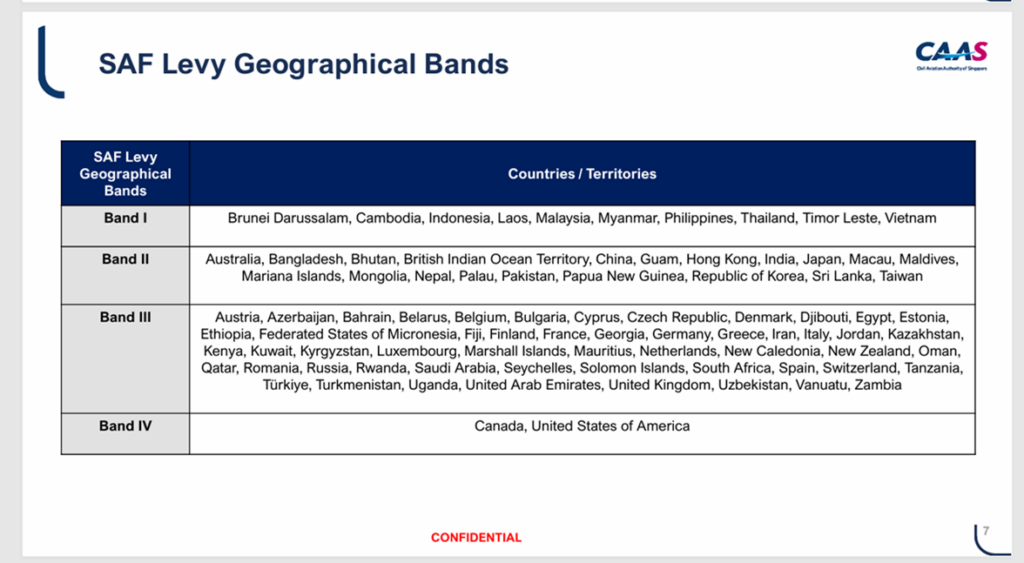
The levy bands are structured geographically.
- Band I – Southeast Asia
- Includes nearby regional destinations such as Thailand, Indonesia, Malaysia, Vietnam, and the Philippines.
- Band II – Asia-Pacific and South Asia
- Includes destinations such as Australia, India, Japan, China, South Korea, Taiwan, and Hong Kong.
- Band III – Europe, Middle East, and Africa
- Includes destinations such as the United Arab Emirates, Saudi Arabia, Qatar, the United Kingdom, France, Germany, and South Africa.
- Band IV – North America
- Includes flights departing Singapore with the next destination in the United States or Canada.
SAF levy amounts for business aviation
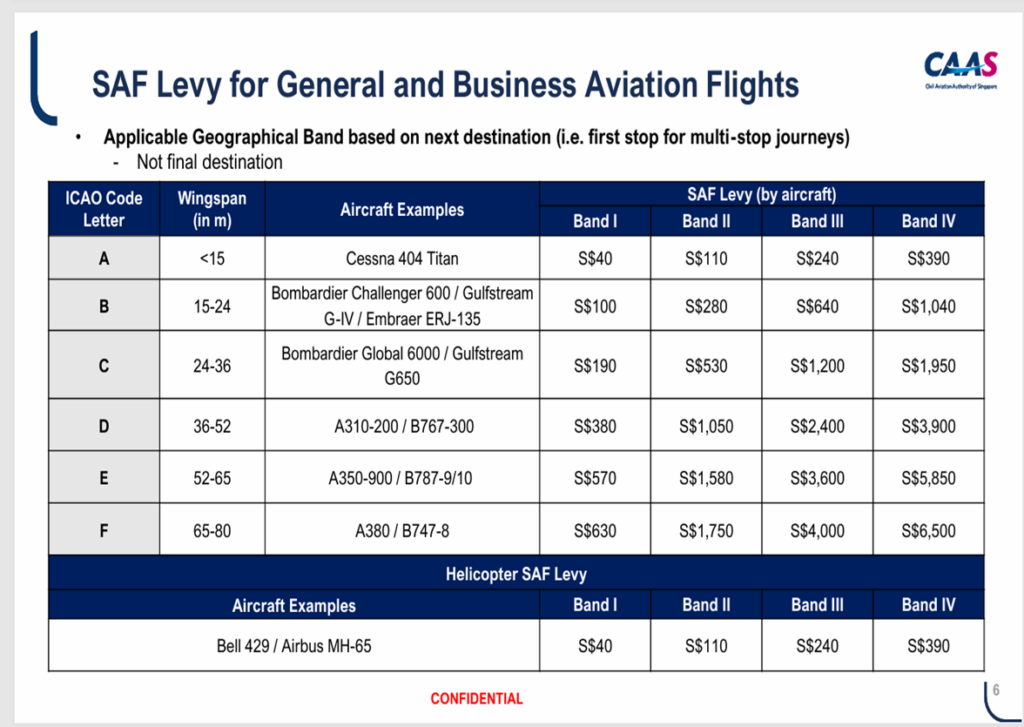 The levy is charged per aircraft per departure and increases with aircraft size and flight distance.
Examples include:
Code B aircraft (e.g., Challenger 600 / Gulfstream IV)
- Band I – S$100
- Band II – S$280
- Band III – S$640
- Band IV – S$1,040
Code C aircraft (e.g., Global 6000 / Gulfstream G650)
- Band I – S$190
- Band II – S$530
- Band III – S$1,200
- Band IV – S$1,950
Larger commercial aircraft categories see higher levies, with the maximum reaching S$6,500 per departure for very large aircraft.
Exemptions to the SAF levy
Several categories of flights will be exempt from the levy. These include:
- Ferry or positioning flights conducted for maintenance purposes
- Flights diverted to Singapore due to weather or technical issues
- Technical stops for fuel or crew changes
- Aircraft operating on aviation gasoline
- Military and diplomatic flights
- Humanitarian and search-and-rescue missions
- Approved training flights
What this means for operators
The SAF levy represents a new operational cost for flights departing Singapore, although the amounts are relatively modest compared with typical trip support expenses.
Operators planning departures from Singapore after October 2026 should factor the levy into trip budgeting and charter pricing, particularly for long-range flights to Europe or North America where higher levy bands apply.
“While the levy introduces an additional cost component, the structure is straightforward and predictable for operators,” said Syed Hussain, Assistant Manager – Operations, Universal Aviation Singapore. “Because the charge is tied to aircraft category and the next destination, operators can easily anticipate the levy during trip planning and incorporate it into their operational budgets.”
Industry context
Singapore joins a growing number of jurisdictions implementing policies designed to accelerate SAF adoption across the aviation sector. Rather than requiring individual aircraft to uplift SAF directly, the levy helps support SAF supply and blending within the broader aviation fuel system.
As SAF production continues to expand globally, similar mechanisms are expected to become more common across major international aviation hubs.