

UPDATE: eu-LISA Go-Live Timeline Clarified | Voluntary Period Begins January 9, Mandatory April 10

The European Union has confirmed a phased rollout of eu-LISA traveler screening systems, with voluntary participation beginning January 9, 2026, and mandatory carrier participation effective April 10, 2026. While applicability to private flights has not been formally excluded, business aviation operators should expect to be treated as carriers and plan accordingly.
What to Do Now
- Review whether your flight department operates into the Schengen Area from outside the common area.
- Begin the eu-LISA carrier registration process early to avoid processing delays closer to the mandatory deadline.
- Confirm internal ownership of the carrier account, even if a third-party service provider will submit manifests.
- Monitor updates on EES and ETIAS implementation, as requirements and timelines continue to evolve.
There has been increasing industry discussion in recent weeks regarding the launch of the European Union’s traveler screening systems managed by eu-LISA. With client inquiries already increasing, operators should be aware of updated timelines, applicability guidance, and what this means for business aviation operations into the Schengen Area.
Here’s the latest information.
Current eu-LISA Implementation Timeline
The European Union has confirmed a phased rollout of the Entry/Exit System (EES), followed later by the European Travel Information and Authorization System (ETIAS).
- Voluntary use period: January 9 through April 9, 2026
- Mandatory carrier participation: April 10, 2026
- ETIAS implementation: Expected October 2026
This updated approach includes a four-month voluntary trial period prior to mandatory enforcement.
What Is eu-LISA?
eu-LISA is the European Union agency responsible for managing large-scale IT systems that support border management and traveler screening for the 29 Schengen member states.
Once fully implemented, operators transporting passengers into the Schengen Area will be required to register as a carrier and submit traveler data through the eu-LISA carrier interface prior to arrival.
This represents a shift of certain pre-travel verification responsibilities to aircraft operators.
Phase 1: Entry/Exit System (EES)
The Entry/Exit System will require operators to electronically verify the visa status of third-country nationals traveling to the Schengen Area.
Key points for operators:
- EES replaces manual passport stamping
- It tracks entry, exit, and overstay status
- It is not a new visa requirement
- Existing visa exemptions remain unchanged
EES applies only to short-stay visas that are electronically linked to a passport. The system cannot verify residence permits, residence cards, or long-stay visas.
Phase 2: European Travel Information and Authorization System (ETIAS)
ETIAS will function similarly to the U.S. ESTA program.
- Applies to visa-exempt travelers
- Requires pre-travel authorization prior to arrival
- Expected implementation: October 2026
A firm ETIAS go-live date has not yet been announced.
What This Means for Business Aviation
While early regulatory language appeared to focus on commercial airlines, eu-LISA has recently clarified that it will not issue a formal determination on whether private flights are excluded from carrier registration requirements.
The definition of a carrier used by eu-LISA is broad:
“Any natural or legal person whose occupation it is to provide passenger transport by air, sea, or land.”
Based on this definition and historical precedent in Europe, business aviation operators operating into the Schengen Area should expect to be treated as carriers.
Our recommendation is that all flight departments operating to Europe register with eu-LISA. Operators who are not registered will not be able to connect to the system.
Carrier Registration Process
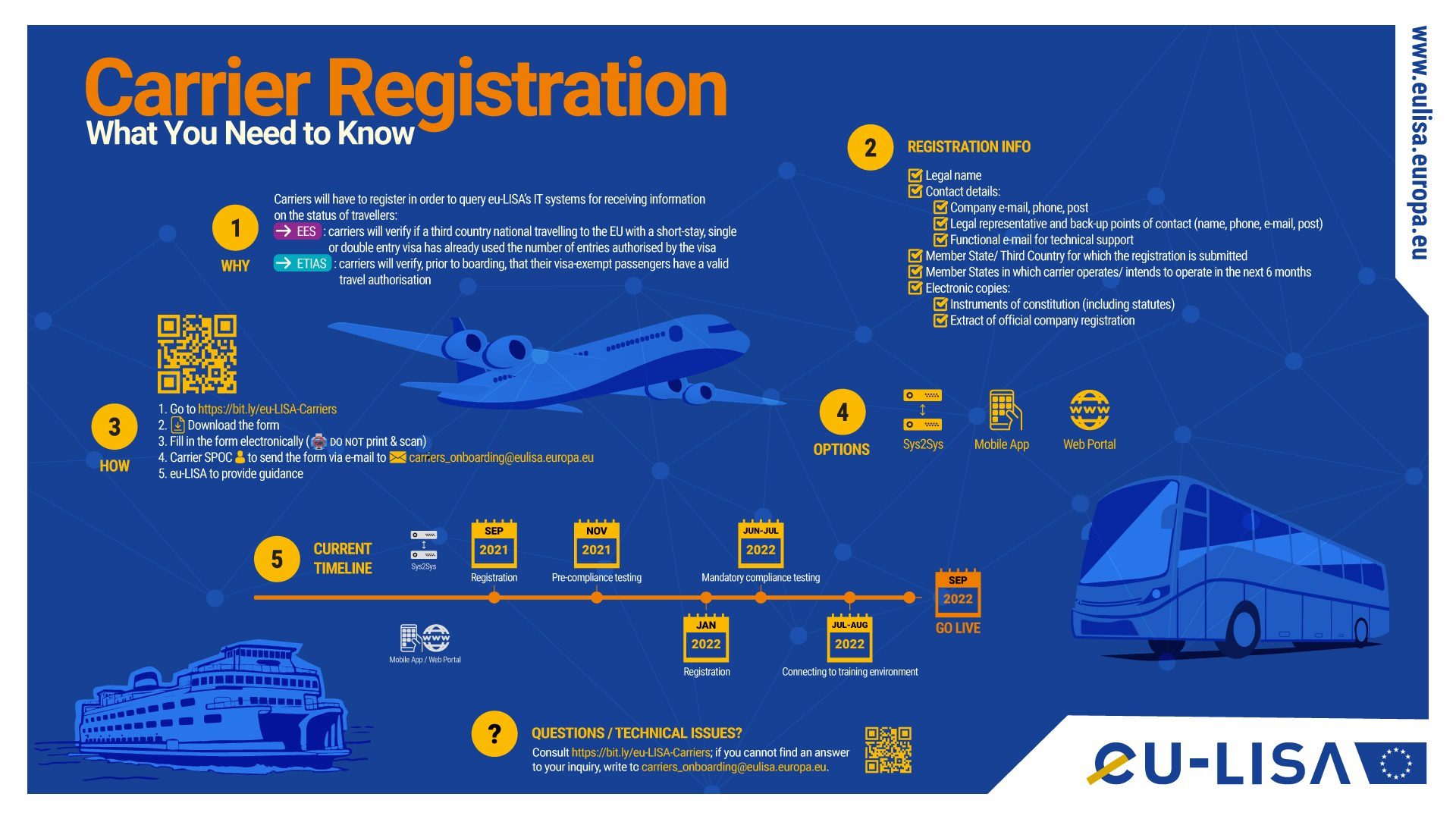 Aircraft operators must submit a Carrier Registration Form (F01), which includes:
- A designated Single Point of Contact (SPOC)
- Instruments of constitution (articles of association, certificate of incorporation, or equivalent)
- An extract of company registration showing legal status
- An Air Operator Certificate may substitute for company registration
- Declaration of intended connection method:
- Web browser
- Mobile application
- System-to-system integration
- Or designation of a third-party service provider
Once registration is complete, the operator is issued a unique carrier ID code, which is referenced in manifest submissions.
If a service provider is designated, the operator must still maintain ownership of the carrier account. Third parties may submit traveler data but cannot perform administrative actions on the operator’s behalf.
How Universal Will Support eu-LISA Submissions
eu-LISA will be managed through Universal’s Global APIS action list; however, it is not an APIS clearance system.
The carrier interface verifies:
- Short-stay visa validity
- Remaining authorized entries
- ETIAS authorization status, when applicable
Additional operational notes:
- Submissions apply only to arrivals into the Schengen Area from outside the common area
- Universal will submit crew and passenger manifests no sooner than 48 hours prior to departure
- Responses are returned as OK or Not-OK, similar to UK GAR
- A Not-OK response is not a denial of travel
- Operators must manually verify documents when required
- Final boarding decisions remain the operator’s responsibility
Universal will not submit manifests during the voluntary period beginning January 9. As participation is voluntary until April 10, there will be no operational impact to clients during this phase. Further announcements will be issued once Universal is ready to go live with mandatory submissions.
Why Early Registration Still Matters
Even with a voluntary rollout period, carrier registration can take weeks and requires document validation. As deadlines approach, last-minute registrations historically lead to processing delays and operational risk.
Early preparation remains the most effective way to avoid disruption once participation becomes mandatory. If you want assistance, we can help. Visit our website.
More Information
For further details on eu-LISA, EES, and ETIAS, refer to the following official resources:
-
Revised EES and ETIAS Implementation Timeline (March 2025 Update):
https://travel-europe.europa.eu/revised-timeline-ees-and-etias-2025-03-07_en -
Official eu-LISA Website:
https://www.eulisa.europa.eu/ -
Entry/Exit System (EES) Overview:
https://travel-europe.europa.eu/ees_en -
European Travel Information and Authorization System (ETIAS) Overview:
https://travel-europe.europa.eu/etias_en -
EBAA’s Position on eu-LISA Requirements for Business Aviation:
https://www.ebaa.org/ -
NBAA’s Advocacy for Business Aviation Compliance with EU Regulations:
https://nbaa.org/ -
Universal Global Regulatory Services (Assistance with eu-LISA Registration & Compliance):
https://www.universalweather.com/