


British Grand Prix 2026: Business Aviation Guide

For more information on operating to the UK, visit our destination and regulatory guides:
The 2026 British Grand Prix takes place July 2-5 at Silverstone Circuit, approximately 90 minutes northwest of London.
Silverstone forces you to build an operation without a primary airport sitting next to the venue. You are choosing between distance, parking probability, and operating constraints rather than solving for proximity alone. Traffic does not peak only on Sunday; it builds through Friday and Saturday because of the sprint format.
The biggest mistake operators make is treating Silverstone as a race event rather than a London-capacity event. The race may take place in Northamptonshire, but the operational pressure extends across airports, hotels, transportation providers, and helicopter operators throughout southern England.
What drives outcomes here is the chain:
Parking availability → Slots and operating restrictions → Ground transportation and helicopter lift → Crew accommodations → Departure timing
The missions that run smoothly are usually the ones that solve the entire chain early. The ones that struggle often solve one piece at a time and discover constraints only after flexibility has disappeared.

Key Planning Questions
What is the biggest mistake operators make when planning a British Grand Prix trip?
Treating Silverstone as a race event rather than a regional capacity event. Parking, slots, transportation, crew accommodations, and departure flexibility all interact. The race takes place in Northamptonshire, but the operational pressure extends across southern England.
Which airport is best for British Grand Prix operations?
There is no universal answer. London Luton (EGGW) offers proximity, Oxford (EGTK) offers convenience for some mission profiles, and London Stansted (EGSS) often provides greater operational flexibility. The best option depends on parking availability, aircraft performance, schedule requirements, and the level of flexibility needed throughout the trip.
Why do missions become more difficult closer to race weekend?
Because parking, transportation, helicopter lift, and accommodations become increasingly constrained while schedule flexibility decreases. Operators who secure these elements early generally retain more options when conditions change.
Access Decisions: Proximity Loses to Availability
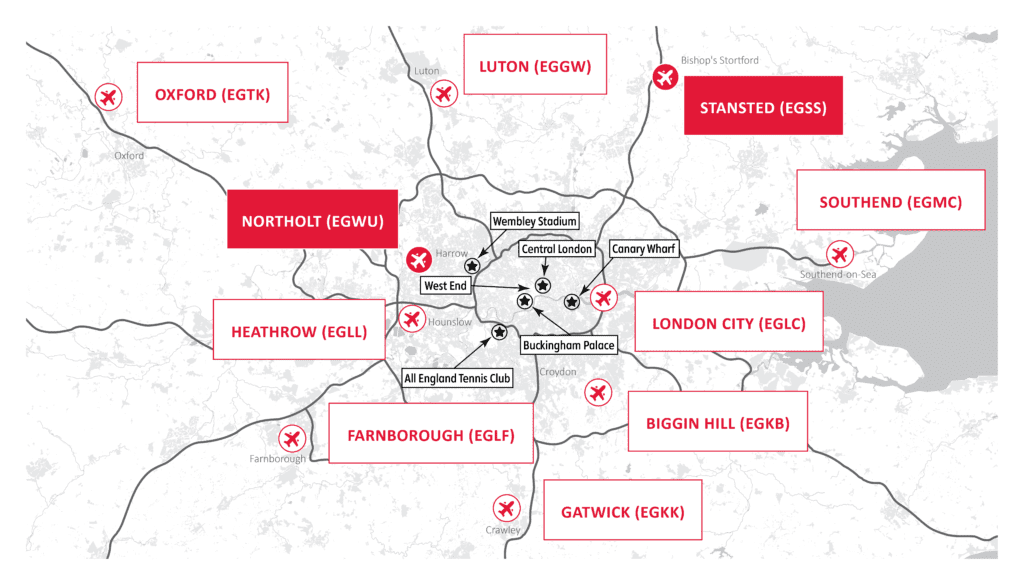
London Luton (EGGW), Oxford (EGTK), and London Stansted (EGSS) all work on paper. The differences appear once you attempt to secure parking and align it with the schedule.
London Luton (EGGW)
Luton is usually the first airport operators consider because it is one of the closest practical options to Silverstone.
Distance to Silverstone: Approximately 40 miles
Typical drive time: Approximately one hour before race-week traffic
The failure point is assuming proximity guarantees access. It does not.
Slots are required, demand remains heavy throughout the summer event season, and parking inventory can become constrained well before race weekend. A schedule adjustment may put an operation outside originally secured parking or slot allocations, and recovery options inside the airport can be limited.
The adjustment that works is committing early and protecting the schedule. Operators requiring flexibility are often better served identifying a contingency airport from the outset rather than assuming changes can be absorbed later.
“Operating at Luton Airport might be second nature for a lot of operators, but during special events like Silverstone we often see a high numbers of new aircraft/operators who are sometimes not prepared for the operational constraints that persist around events of this sort. Fortunately, with the rise in popularity of Formula 1 in the USA, more and more of our customers know what to expect and how best to plan for it. The key consideration here is to prepare your clients to be aware of the need for flexibility and build time in from the start of the mission plan to enable the mission to be completed. Education of all of those in the mission ecosystem will pay dividends when it comes to fulfilling successful outcome. On the day, our team will constantly be moving slots and amending schedules depending on the situation at hand; but don’t worry – whether it’s Wimbledon, a football match, or Silverstone, we’ll have our team on hand to guide you through.”
When it goes wrong, the result is usually a late airport change that affects every other component of the mission.
Oxford (EGTK)
Oxford solves the distance problem but introduces a runway consideration.
Distance to Silverstone: Approximately 30 miles
Typical drive time: Approximately 45-60 minutes before race-week traffic
The airport’s 5,092-foot runway means aircraft performance should be evaluated early. Teams that assume a GA-focused airport automatically works for every aircraft profile sometimes discover late that payload, fuel, weather, or alternate requirements create limitations.
The fix is straightforward but must happen early: validate aircraft performance before parking, hotels, transportation, and crew arrangements are built around Oxford.
When this goes wrong, operators often lose not only the airport but also the logistics built around it.
London Stansted (EGSS)

Stansted’s role as a contingency option becomes even more important in 2026 following the closure of Coventry Airport (EGBE) in June, removing a historical alternate used by some operators during previous British Grand Prix events.Stansted offers a different advantage: operational flexibility.
Distance to Silverstone: Approximately 70 miles
Typical drive time: Approximately 90 minutes before race-week traffic
With a 10,000-foot runway, 24-hour operations, extensive support infrastructure, and generally stronger parking prospects than more constrained London-area airports, Stansted often becomes the airport that preserves options rather than restricting them.
What breaks here is the assumption that distance automatically makes it the least attractive choice.
During Grand Prix week, operators frequently avoid Stansted because of the longer drive, only to end up there later after parking or scheduling constraints emerge elsewhere.
“Stansted is often overlooked for Silverstone because it’s on the north-east side of London rather than the north-west, but focusing purely on geography can mean missing some significant advantages. For many operators, Stansted offers more competitive fuel pricing, a longer runway, excellent operational flexibility and, crucially, far fewer slot restrictions than some of the more congested alternatives.
The key consideration is not simply the road transfer time, but the overall efficiency of the trip. In my experience, nine times out of ten, if Luton is approaching capacity, Stansted will still be able to accommodate your preferred arrival or departure time. That flexibility can easily outweigh the additional drive time, potentially saving hours across the course of a busy event schedule.
When you combine greater slot availability with competitive fuel costs and the operational benefits of a major international airport infrastructure, Stansted frequently delivers a more efficient and cost-effective solution than many visitors initially expect.
Having spent over a decade championing the benefits of Stansted, I’ve seen countless operators try it once and then continue coming back time after time. Ultimately, that’s the strongest endorsement possible—those who experience the advantages of Stansted first-hand rarely need convincing a second time.”
The correction is treating Stansted as a primary option from the beginning whenever aircraft size, schedule flexibility, or longer stays matter more than minimizing drive time.
Most Common Operational Mistakes
Several planning errors appear repeatedly during British Grand Prix operations:
- Selecting an airport based solely on proximity to Silverstone.
- Assuming visible ramp space guarantees parking availability.
- Evaluating parking after hotels and transportation have already been arranged.
- Waiting to secure helicopter lift until after the operating schedule is finalized.
- Building race-day departure plans with little schedule flexibility.
- Assuming previous years’ airport strategies will remain viable without verifying current conditions.
Most of these issues are manageable when identified early. The challenge is that they often emerge only after other parts of the mission have already been built around a specific airport or schedule.
Parking Reality: The Earliest Decision You Still See Made Late
Parking is where many British Grand Prix plans begin to fail.
Not because every ramp is physically full, but because workable combinations of aircraft size, parking duration, and timing become increasingly difficult to secure.
What breaks is sequencing.
Teams confirm attendance, then evaluate airports, then think about parking. By that stage, Luton may already be constrained, Oxford may only support certain mission profiles, and operators are negotiating around whatever remains available.
The stronger approach is requesting parking as soon as schedules become credible and pairing every primary airport with a defined alternate strategy.
A common failure chain looks like this:
A Global 7500 plans to use Luton because of proximity. Parking becomes unavailable or cost prohibitive. Oxford is evaluated, but runway and payload assumptions no longer align with the mission profile. The operation moves again, this time to Stansted. Hotels, transportation, and crew accommodations were already built around a different airport strategy.
The mission still operates.
What disappears is flexibility.
“Quite often, the view of the ramp doesn’t match our capacity figures. Parking peaks at various periods over a day or race weekend (usually peaking overnight as well), and this has to be taken into consideration when accepting any additional flights. Our team has to weigh up the risk vs reward of our capacity – juggling potential delays, cancellations, tech issues or ATC imposed CTOTs. Book too many in and have a delayed departure and an AOG, then you can soon find that you have nowhere to park that ‘small’ GL7500. We seek to have our hangars and ramps full overnight and operational during the day – so there should always be space for a turnround, and we have a ready made solution at Stansted for parking should the need arise.”
Slots, Restrictions, and What They Do to Your Schedule
Only one of these airports forces slot discipline at scale: Luton.
The failure point is treating slots as an administrative requirement rather than an operational constraint.
When schedules move, slots may not. Once timing changes, transportation arrangements, helicopter transfers, crew logistics, and passenger movements can all become misaligned.
The practical solution is building around fixed schedules if operating through Luton. If schedule flexibility is required, many operators are better served selecting an airport capable of absorbing timing changes more effectively.
Flexibility is easier to build into the airport decision than it is to recreate later.
Ground Movement: Where Plans Look Fine Until Race Traffic Hits
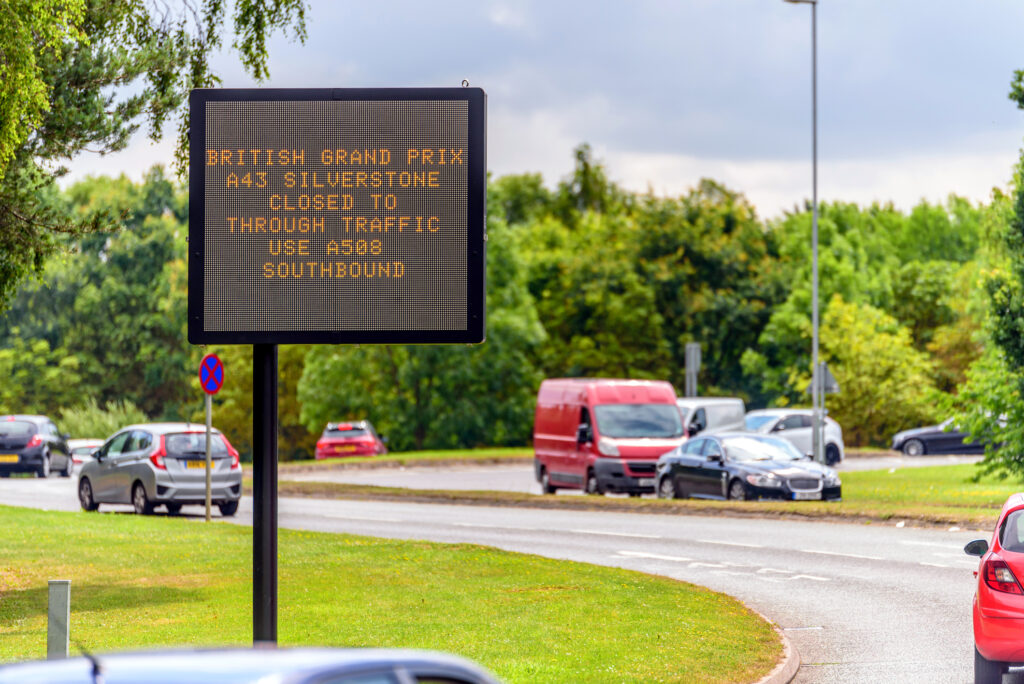
Distances around Silverstone appear manageable on paper.
The problem is assuming normal drive times continue during race weekend.
They do not.
Transportation availability narrows while travel times increase. That combination creates missed circuit arrivals, delayed returns to the airport, and increasing pressure on departure schedules.
The adjustment is securing transportation early and building realistic buffers around peak movement periods on Friday, Saturday, and Sunday.
When ignored, even a perfectly timed landing can turn into a delayed circuit arrival, with pressure shifting onto the departure later in the day.
Helicopter Lift: Effective, but Not On Demand
Helicopters work at Silverstone because they remove the road-congestion variable.
The failure point is assuming helicopter lift can be arranged later.
Demand is consistently high during race week. Operators who wait often discover that available capacity no longer aligns with their arrival and departure schedules.
The solution is simple: secure helicopter lift when the airport and operating schedule are finalized, not afterward.
If you do not, you often fall back to ground transportation during peak congestion periods, which can shift the entire day’s timeline.
Crew Accommodations: Tied to the Airport Choice
Hotels near Silverstone tighten early.
Rates increase, minimum stays appear, and cancellation terms become more restrictive.
The common mistake is treating accommodations as separate from airport planning.
When airport selections change late, hotel strategies often fail alongside them.
The stronger approach is securing accommodations alongside the primary airport strategy and maintaining options near likely contingency airports.
When missed, crews frequently end up with longer commutes, fragmented stays, and increased pressure on reporting times.
Departure Pressure: Monday Is Not a Relief Valve
Departure demand remains elevated after the race.
The failure point is building rigid departure schedules on Sunday or Monday with little room for movement.
A second failure chain appears here.
An operation arrives through Luton with fixed slots and limited parking flexibility. Transportation delays occur after the race. Passengers arrive back at the airport later than expected. Departure timing no longer aligns with the original plan.
At that point, operators are attempting to negotiate flexibility inside an already saturated operating environment.
The stronger strategy is protecting race-day schedules with realistic buffers and considering airports capable of absorbing timing changes if departures cannot tolerate movement.
The Operational Reality That Holds Everything Together
At Silverstone, the airport is rarely the problem.
The planning sequence is.
The operators who secure parking, transportation, accommodations, and contingencies together generally operate smoothly. The operators who solve those pieces one at a time usually discover the constraints only after flexibility has disappeared.
The missions that run clean during the British Grand Prix are not necessarily the ones that picked the closest airport. They are the ones that secured parking early, matched the aircraft to the airport’s real limitations, aligned transportation with the arrival plan, and protected the departure with flexibility or buffer.
Ignore any one link in that chain and the problem rarely stays isolated. It usually appears later, when there are fewer options available to solve it.